
Maya Bundle Exchange
Build a Maya asset library: create assets, migrate MA/MB/FBX files, organize variants and place them in your scene.
Build a Maya asset library: create assets, migrate MA/MB/FBX files, organize variants and place them in your scene.
Explore 20 illustrated topics with step-by-step workflows and explanations of the controls: library setup, asset creation, MA/MB/FBX migration, variants, previews, viewport placement, team reviews and portable scene exchange.
Create an Asset from Selection or Scene
Save selected objects or the current scene with collected dependencies, a preview and searchable asset metadata.
Prepare and save
Create a reusable asset from the current Maya edits. Saving the source scene first is not required. Select the asset’s transforms when you only want part of the scene.
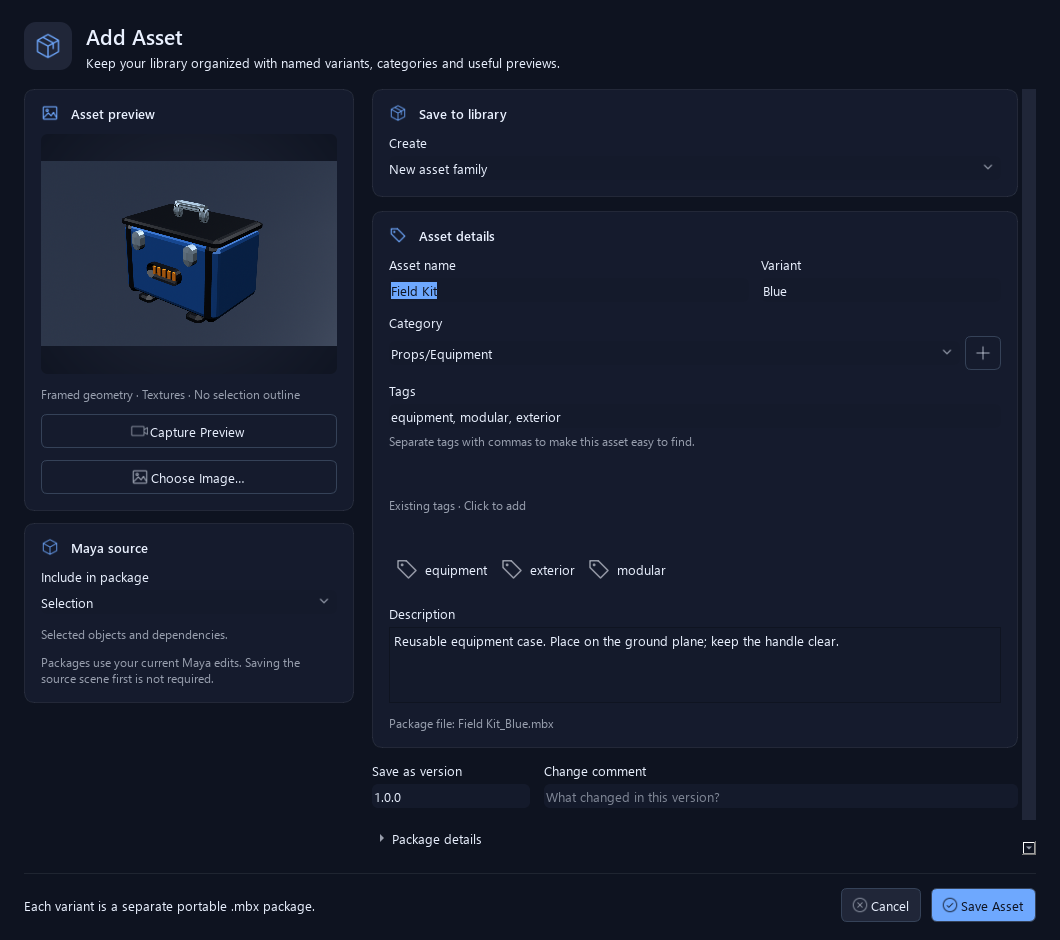
- Choose Add Asset > Add Selection as Asset… or Add Current Scene as Asset….
- Check Include in package. Selection collects the selected objects and their dependencies; Current scene includes the whole scene.
- Capture a preview or choose an image, then enter the asset name, variant and category.
- Add searchable tags and a useful description. Check the suggested package filename, then choose Save Asset.
- Wait for packaging to complete and inspect the new entry in the browser. Review any reported dependency errors before trying again.
Source and library destination
The source scope and the asset identity are separate choices.
- Include in package
- Selection or Current scene. Changing the scope requests a new capture when a capture callback is available; inspect the preview again before saving.
- Create
- New asset family starts a separate asset. New variant of existing asset adds a named alternative to a selected family.
- Asset family
- Available when creating a variant. Select the existing family; its name and category are used for the new variant.
- Asset name / Variant
- Both must be non-empty. Use a clear asset name such as Field Kit and a variant name such as Blue.
- Category
- Choose a category or enter a subfolder path. The plus button creates a category. Leave the category empty for Uncategorized.
- Tags
- Comma-separated search terms. Suggestions help reuse existing library tags.
- Description
- Explain intended use, scale, dependencies or anything the next artist should know.
- Package details > Author
- Optional author or studio information stored with the asset.
Check the result
A useful library asset has an intentional origin, sensible scale and a recognizable thumbnail. Test its placement in a scene before sharing.
How do I install and open MBX?
Install Maya Bundle Exchange through AO.Hub with your free account. Launching MBX opens AO Asset Browser. In Settings, choose an existing writable folder for the library. After an update, restart Maya so all changed modules and the placement plugin reload.
Can I import existing MA, MB and FBX files?
Yes. Drop files onto the browser asset area or use Add Asset > Migrate Asset Files… to scan a folder. Review names, categories and checkboxes, then choose Migrate checked. One source file becomes one MBX asset; the converter does not split each object into its own asset.
Does migration change my source files or open Maya scene?
No. Each source is processed separately from your working scene. The source file remains untouched and an existing output name is skipped. Keep source and destination folders separate, with neither folder inside the other.
What happens to MA/MB references?
Referenced MA/MB scenes are loaded and embedded into the migrated scene, including applied reference edits. The new asset contains their effective scene content, rather than the original editable reference hierarchy. Keep your original source project when you need that hierarchy.
Where does migration look for textures?
MA/MB paths are resolved from each owning source scene and its source project, including relevant nearby sourceimages or textures folders. The current working project is not used as a fallback. Ambiguous matches are reported instead of choosing a same-named image arbitrarily.
Why did an asset get a WARNING instead of READY?
A package was created, but its report contains information to review, such as missing textures, preview issues or embedded references. WARNING does not always mean the package is unusable. Select the row and inspect its diagnostics before reuse.
Can I reject files with missing textures?
Yes. Turn off Package with missing textures before migration. It is enabled by default. Missing references, other blocking dependencies, unknown required nodes or geometry-free inputs can still fail even when missing textures are allowed.
What should I check after converting FBX?
Check materials, texture paths, animation and scale in Maya. FBX import can lose Maya-specific tiled-texture or image-sequence settings. MBX packages the result that Maya imports; it does not turn FBX into a lossless Maya scene format.
What happens to duplicates, failures and cancellation?
An existing output filename is SKIPPED; edit the asset name or category to create another output. FAILED rows report their error, and the batch continues with other files. Cancel waits for the current operation to finish safely and stops before the next asset; completed packages remain available.
What is the difference between Import, Reference, Open and Unpack?
Import adds content to the current scene; Reference creates a Maya reference to the extracted asset content. Both load resources from a managed local cache. Open replaces the current Maya scene after checks. Unpack Scene collects the opened MBX scene and its resources into a Maya project or directory.
Which data travels in an MBX package?
The package includes the scene data, collected resources, previews, asset metadata and integrity information. Library review notes and tag colors are separate shared library records; favorites and recent history are local.
Why do I still need Maya and renderer plugins?
MBX carries detected resource files, not installed Maya plugins or renderers. Use a compatible Maya installation with the required plugins. Migration also needs the mayapy runtime supplied with Maya; FBX input needs its FBX importer.
What does Remove from Index do?
It removes the browser index entry but keeps the .mbx file on disk, so a refresh may rediscover it. Delete Variant Permanently… deletes that variant package; Delete Asset Permanently… deletes the family packages. These are different operations.
Which platforms are listed as supported?
The website lists Windows and macOS for AO Studio Tools. Windows Explorer thumbnails and file association features apply only to Windows.